
Cal.com: Workflow Actions & Triggers
Cal.com: The Open-Source Scheduling Stack
Cal.com is the open-source scheduling stack used by individuals and teams to take bookings on their own terms. The Cal.com integration adds a scheduling layer directly into the Workflow Builder, allowing customer-facing automations to respond to booking events and vice versa. Booking lifecycle triggers and four booking actions cover the most common Cal.com use cases without requiring webhook plumbing or third-party connections.
For example, a new booking for a discovery call event type can trigger a personalised welcome sequence within the same workflow that processed the form, eliminating manual hand-offs and reducing overhead.
Integration Components
The integration consists of two parts:
- Triggers (Cal.com → Workflows): Webhook-backed booking lifecycle events — Booking Created, Booking Rescheduled, Booking Cancelled, Meeting Ended, and Out of Office Created / Updated.
- Actions (Workflows → Cal.com): Four actions — Create Booking, Cancel Booking, Reschedule Booking, and Find Booking — which cover the most common booking operations.
All triggers and actions are designated as premium — premium action credits apply at the standard automation rate.
Key Benefits of Cal.com in Workflows
- Full Booking Lifecycle Coverage: Manage all booking stages — created, rescheduled, cancelled, ended, and (where supported) recording ready, all from a single connected source of truth.
- Webhook-Speed Triggers: Typically fires within 1–3 seconds of the booking event, with no polling lag.
- Programmatic Scheduling: The Create Booking action allows workflows to book on behalf of attendees without needing to send a booking link back and forth.
- Mapping Reference: Choose a recent booking as a schema reference so every subsequent step aligns with typed fields smoothly.
- Rich Payload: Each trigger provides the full booking object — bookerUrl, title, startTime, endTime, additionalNotes, type, description, eventTypeId, hideCalendarNotes, attendees, and organiser — allowing any field to be utilised downstream.
Connecting Cal.com
Before any Cal.com trigger or action can run, the integration must be connected. This allows your workflows to securely receive Cal.com webhooks and call the Cal.com API on your behalf.
Connect via the Workflow Builder (Recommended)
- Open Automation → Workflows and select (or create) a workflow.
- Add a Cal.com trigger or action — search for Cal.com in the Apps tab.
- Select any Cal.com trigger or action.
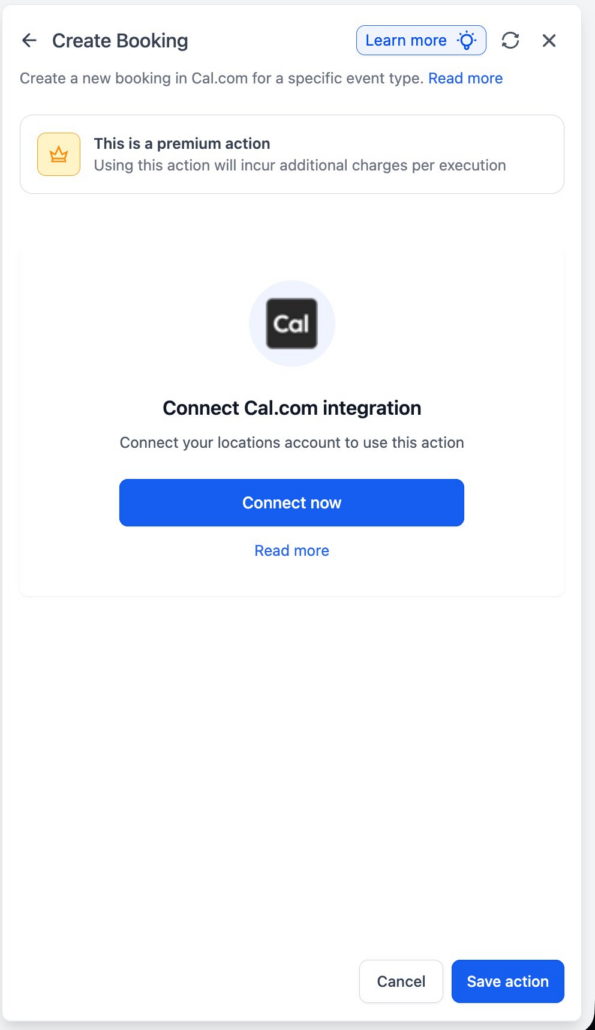
- On the action card, click Connect Now.
- Paste your Cal.com API key (or sign in via OAuth, where available); authorise the workspace and event types you wish to expose.
- Click Save to complete the connection.
Connect via Settings (Alternative Path)
- Go to Settings → Integrations.
- Locate Cal.com in the integrations list and click Connect.
- Authenticate and authorise.
Triggers
All triggers are instantaneous — powered by Cal.com webhooks and firing within seconds of the underlying event:
- Booking Created: Fires when a new booking is created in Cal.com, returning the full booking payload.
- Booking Rescheduled: Fires when an existing booking is moved to a new start time, returning both new and previous times.
- Booking Cancelled: Fires when a booking is cancelled by the attendee, organiser, or system, returning the cancellation reason if provided.
- Meeting Ended: Automatically fires at the scheduled end time of the booking and re-arms automatically upon rescheduling.
- OOO Created / Updated: Fires when an out-of-office entry is created or updated.
Actions
- Create Booking: Creates a new booking for a specific event type. Required: Event Type, Attendee Name, Attendee Email, Start Time.
- Cancel Booking: Cancels an existing booking by ID, with an optional cancellation reason.
- Reschedule Booking: Moves an existing booking to a new start time. Cal.com handles invite refresh and notifications.
- Find Booking: Looks up a booking by ID or attendee email; returns the matching booking(s).
Example: Setting Up a Trigger (Booking Created)
This walkthrough demonstrates how to configure a workflow that triggers each time a new booking is made on Cal.com, using the booking payload as the basis for subsequent actions.
- Add the Trigger: Open the workflow and click Add Trigger. Switch to the Apps tab and search for Cal.com, then select Booking Created from the trigger list.
- Configure the Trigger:
- Workflow Trigger Name — Give the trigger a meaningful label, such as ‘New Discovery Call Booking’.
- Add filters (optional) — Constrain the trigger by event type, host, location, or any other field on the booking payload to exclude unrelated bookings.
- Webhook Status — The trigger panel indicates whether the Cal.com webhook is active. If it becomes inactive, reconnect the integration in Cal.com settings.
- Test the Trigger: Click Find New Records within the Test Your Trigger panel. The system fetches the most recent matching bookings from Cal.com. In the Records — Select Mapping Reference dropdown, choose one of the returned records (e.g., Active: (2026-05-01 10:36:24) Reference 69f434d0e7358049c8b16ded). This locks the payload schema for clear downstream mapping. Confirm the Trigger Data Response panel displays the fields you intend to use — bookerUrl, title, startTime, endTime, additionalNotes, type, description, eventTypeId, hideCalendarNotes, attendees, and organiser. Click Save Trigger to complete.
Example: Setting Up an Action (Create Booking)
This walkthrough demonstrates how to programme a meeting booking on a host’s calendar from within a workflow — for instance, after a high-intent form submission.
- Add the Action: Inside the workflow, click Add to insert a new step. Open the Apps tab and select Cal.com, then choose Create Booking from the action list.
- Connect (First Time Only): If the integration is not yet connected, click Connect Now on the action card. Paste your Cal.com API key and authorise the workspace.
- Configure the Action:
- Action Name — Give the step a meaningful label, such as ‘Book Discovery Call’.
- Event Type (required) — Select the Cal.com event type for booking. The dropdown lists every event type authorised for integration access.
- Attendee Name (required) — Use inline workflow variables, e.g. {{contact.full_name}}.
- Attendee Email (required) — Use inline workflow variables, e.g. {{contact.email}}.
- Attendee Timezone — Use IANA format, e.g. America/New_York or Europe/London. Defaults to the sub-account timezone if not specified.
- Start Time (required) — Present in the suggested format (e.g. 12-21-2026 08:30 AM) or ISO-8601. The interpreted timezone is the Attendee Timezone (or sub-account default if unset).
- Save and Use the Output: Click Save action. The new booking’s ID and metadata become available as workflow output variables. You can then send a confirmation email or SMS to the attendee, or use the booking ID later in a Cancel Booking or Reschedule Booking step if conditions change later.
How to Test the Trigger and Action
Always test before publishing. Testing locks the payload schema and provides real records for mapping in downstream steps.
Test the Trigger:
- Within the trigger panel, click Find New Records.
- Select a recent booking from the dropdown as the mapping reference.
- Ensure the Trigger Data Response shows the intended fields for downstream use.
- Verify the Webhook Status indicator reads ‘active’.
Test the Action:
- In the action panel, click Test Action.
- The action runs against the live Cal.com workspace using sample values.
- Verify the booking appears in Cal.com (and on the host’s calendar) at the expected time and timezone.
- If the result is incorrect, recheck the Start Time format and the Attendee Timezone, then retest. Once satisfied, click Save action, then perform a full Test Workflow before publishing.
Use Cases
Use Case 1: New Booking → CRM Contact + Welcome Sequence
Goal: Turn every new booking into a fully onboarded contact with the right context attached.
Workflow Setup:
- Trigger: Booking Created
- Action: Create/Update Contact (using attendee email as the merge key)
- Action: Tag the contact with the booking’s event type
- Action: Send Welcome Email with preparation materials tailored to the meeting type
- Action: Add the contact to a follow-up campaign that concludes 24 hours before the meeting
Example: A prospect books a 30-minute discovery call. The workflow creates a contact, tags them as ‘discovery’, sends a personalised preparation email, and ensures a reminder is sent the day before the call.
Use Case 2: No-Show Recovery
Goal: Automatically recover no-shows without needing a CSM to track them down.
Workflow Setup:
- Trigger: Meeting Ended
- Action: Find Booking (refresh state to capture no-show flag)
- Conditional: proceed only if the attendee was a no-show
- Action: Send a personalised rescheduling link for easy rebooking
- Action: Tag the contact for follow-up if no rebooking occurs within 48 hours
Example: When a meeting concludes, the workflow checks the booking state. If the attendee was a no-show, they receive a gentle message and a one-click rebooking link, preventing them from falling through the cracks.
Use Case 3: Cancellation Retention
Goal: View a cancellation as the beginning of a retention strategy rather than a dead end.
Workflow Setup:
- Trigger: Booking Cancelled
- Conditional: branch based on cancellation reason (schedule conflict vs. lost interest)
- Action: Send retention message with a rebooking link (for schedule conflict)
- Action: Hand off to CSM with full context (for lost interest)
Example: A prospect cancels their demo due to a calendar conflict. The workflow sends a friendly rescheduling message with two pre-filled time options, tagging the contact for CSM follow-up if there’s no rebooking within a week.
Use Case 4: Programmatic Scheduling from a Form
Goal: Eliminate the back-and-forth email chain for high-intent leads.
Workflow Setup:
- Trigger: Form Submission (with preferred time captured)
- Action: Create Booking on the assigned host’s event type
- Action: Send confirmation message
Example: A lead requests a same-day call through a high-intent form. The workflow books the meeting on the assigned Account Executive’s calendar at the requested time and confirms it instantly — no manual scheduling, no missed leads.
Use Case 5: Recording Distribution
Goal: Automatically send Cal Video recordings to the appropriate recipients.
Workflow Setup:
- Trigger: Recording Ready (where supported)
- Action: AI summarise the recording into a customer-friendly note
- Action: Send the recording URL and summary to the attendee
- Action: Log a CRM activity with the recording link attached
Example: Immediately after a recording is processed, the attendee receives a thank-you email containing the recording link along with an AI-generated summary — and the CRM activity log captures the same context for the representative.
Additional Tips
- Always specify the Attendee Timezone explicitly when booking on behalf of leads from different regions — relying on the sub-account’s default is suitable only for single-region operations.
- Use the suggested Start Time format (e.g. 12-21-2026 08:30 AM) or ISO-8601 strings. Ambiguous formats can result in booking times shifting by hours.
- Pair Find Booking with Cancel Booking or Reschedule Booking to confirm that the booking exists and is in the correct state before changing it.
- Utilise Meeting Ended (not Booking Created) for post-meeting follow-up flows — Cal.com automatically schedules it and adjusts on reschedule.
- Monitor the Webhook Status indicator in the trigger panel — if it becomes inactive, the underlying webhook must be reconnected in Cal.com settings.
- Test the trigger first to lock the mapping reference, then develop downstream actions based on the captured sample payload. The Records — Select Mapping Reference field is the basis for clear field mapping.
Frequently Asked Questions
Cal.com serves as the open-source scheduling stack for individuals and teams to take bookings on their own terms. It supports both cloud-hosted and self-hosted deployments and offers a comprehensive webhook surface for automation.
- Q: Are Cal.com actions premium workflow actions?
Yes. All four actions are marked as premium and consume premium action credits at the standard automation rate. - Q: How fast do triggers fire?
Cal.com typically sends webhooks within 1–3 seconds of the booking event. Workflows begin as soon as the webhook is received. - Q: What does the trigger payload include?
Every booking event delivers the full booking object — bookerUrl, title, startTime, endTime, additionalNotes, type, description, eventTypeId, hideCalendarNotes, attendees, and organiser. Use Find New Records and the Records — Select Mapping Reference to lock the schema. - Q: What does the Webhook Status indicator mean?
This reflects the live status of the underlying Cal.com webhook. ‘Active’ means events are flowing; if it becomes inactive, the webhook needs reconnection in your Cal.com settings. - Q: How do I supply a timezone in Create Booking?
The Attendee Timezone field accepts IANA format strings, such as America/New_York or Europe/London. If left empty, Cal.com defaults to the sub-account timezone. - Q: What format should I use for Start Time?
A standard date-time value. The suggested format is ‘12-21-2026 08:30 AM’; ISO-8601 strings (e.g. 2026-12-21T08:30:00) are also accepted. The interpreted timezone is the Attendee Timezone (or sub-account default if not specified). - Q: Does Cancel Booking notify the attendee?
Yes. Cal.com sends its standard cancellation email, including the cancellation reason if supplied. - Q: Will Reschedule Booking re-issue calendar invites?
Yes. Cal.com cancels the original calendar event and sends an updated invite for the new time. Confirmation emails are sent automatically. - Q: What happens to Meeting Ended when a booking is rescheduled?
Cal.com cancels the pending Meeting Ended webhook for the original time and reschedules it for the new time. The trigger fires once, at the booking’s actual end. - Q: Will the workflow trigger twice if a booking is rescheduled?
No. Booking Rescheduled is its own trigger; Booking Created does not re-fire on reschedule. Use the appropriate trigger for the lifecycle event you are concerned with. - Q: Does the integration work on self-hosted Cal.com?
Self-hosted Cal.com supports the same webhook surface, so triggers function similarly once the webhook URL is configured. However, some self-hosted setups may have issues with Meeting Started / Meeting Ended — verify with a real test booking before using in production. - Q: Can I use workflow variables in action fields?
Yes. Inline variables work in Attendee Name, Attendee Email, Start Time, and any other field exposed by the action. - Q: What if the booking I am trying to cancel no longer exists?
Cancel Booking surfaces the error in the workflow execution log, and the workflow continues based on its branching. Use Find Booking as a guard step if subsequent logic depends on the cancellation succeeding. - Q: Are these actions production-ready?
All triggers and actions are released as Beta. They are safe to use in live workflows; expect incremental UX changes — additional filters, additional fields — as the integration progresses beyond Beta.